Introduction
Search in private lending has changed. It no longer gives you a list of links; it writes a complete answer for you.
When borrowers, brokers, or investors ask about hard money, bridge loans, DSCR products, or private lending terms, AI systems don’t simply retrieve websites. They assemble answers from structured, authoritative data they trust.
In this new environment, your brand is no longer just "ranked." It is either synthesized into an answer about hard money/private lending or ignored.
If an AI model cannot find structured, authoritative data about your firm, it will guess, or worse, it will recommend a competitor who is easier for the machine to read. AI Search Visibility no longer comes from rankings. It comes from being cited.
The Anatomy of an AI Answer: How Hard Money Lenders Get Recommended (or Ignored)
When a borrower or broker asks an AI, "Who is the most reliable hard money lender for fix-and-flip in NY?", the system follows a specific technical process.
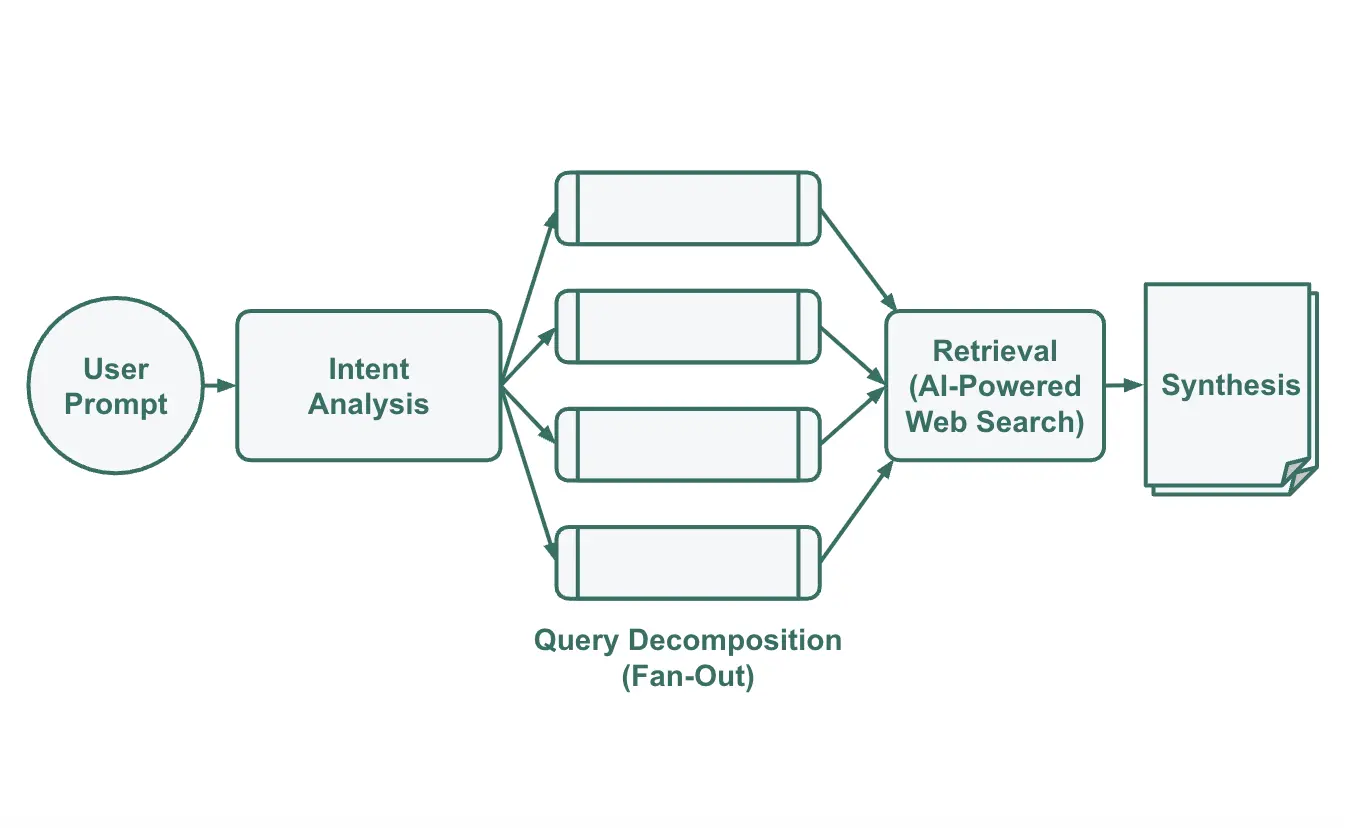
Intent Analysis
The AI identifies the true intent behind the question. Is this a high-volume flipper prioritizing speed and draw flexibility? Is a new investor concerned about leverage and guidance? Or a developer focused on loan size and certainty of execution?
Query Decomposition
The system takes one question and turns it into subqueries. The AI guesses what the user needs and starts its own mini-searches to provide a holistic answer. Of course, if the question were straightforward, “What is the capital of Spain?”, it would not require query decomposition.
These subqueries are aligned to the latent needs like geography (NY), asset type (fix-and-flip), loan structure (hard money), reliability signals (track record, funding certainty), and performance attributes (capital velocity, underwriting flexibility).
Retrieval (AI-Powered Web Search)
Before generating an answer, the model searches across the web across its indexed and trusted data sources.
It looks for structured, machine-readable, authoritative information: company profiles, blogs, videos, reviews, industry mentions, schema markup, knowledge graphs, and other verifiable signals.
If the AI can’t find clear data about your firm, it will ignore you.
Synthesis
Finally, the system evaluates the retrieved candidates and composes a narrative recommendation.
It picks the winners based on who it trusts, not just who uses the right keywords.
The 6-Point AEO Audit: Measuring AI Search Visibility
To win in this ecosystem, you need more than SEO; you need Answer Engine Optimization (AEO). You need to measure your AI Visibility through six technical checkpoints derived from real-world LLM behavior:
- Business Driver Alignment: How often does the AI associate your brand with strategic themes like "Fast Execution" or "Institutional Scale"?.
- Persona Visibility: Does the AI recommend you to your target ICPs, such as "Independent Brokers," or do you have invisibility "blind spots" in key markets?.
- Market Fragmentation: AI search is a "long tail" game. Track your "mentions" across hundreds of prompts to see if you are capturing a dominant share of the conversation.
- Similarity Mapping: Which brands does the AI perceive as your peers? Suppose you want to be grouped with Nationwide Institutional Lenders to signal reliability, but AI groups you with large brokers!
- Source Authority: Identify which domains (aggregators, industry journals, or your own site) the AI uses as its primary "grounding data".
- Perception & Sentiment: Is the AI’s tone Advocacy-based, Neutral, or Critical? Audit for "Power Phrases" that build trust with high-intent users. It is not enough that your domain features in sources of data -> what matters is the perception.
Persona Visibility Report: How AI Associates Your Brand with Brokers, Flippers & Developers (Sample)
Let us understand the significance of the AEO audit. Below is one of six diagnostic reports used to measure AI visibility. This Persona Visibility view shows how frequently AI systems associate a brand with specific Ideal Customer Profiles (ICPs), helping identify positioning strengths and blind spots.
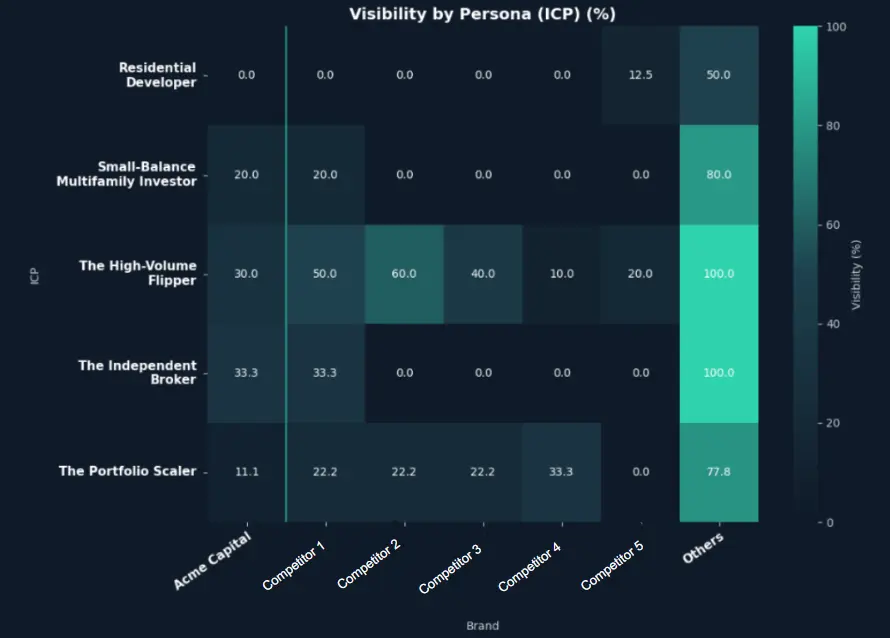
Key Insights
1. Underserved Persona: Residential Developer
Acme Capital receives zero citations for the Residential Developer persona, while competitors capture up to 50% visibility.
This shows a hole in your strategy. AI systems are not currently associating Acme with this segment, and long-tail results show fragmented, inconsistent positioning.
2. Dominant Personas: Independent Broker & High-Volume Flipper
Acme performs strongly for:
- The Independent Broker
- The High-Volume Flipper
Across tested prompts, AI systems recommend Acme more frequently than named competitors for these personas, indicating established narrative strength and clearer entity association.
However, the “Others” category remains materially cited, suggesting that while Acme leads among named competitors, overall market visibility is still distributed, leaving room to consolidate authority.
AI does not distribute visibility evenly. It reinforces clarity. Where your positioning is strong, AI compounds it. Where your entity is ambiguous, AI defaults elsewhere.
Continuous Monitoring: Why AI Visibility Requires Ongoing Optimization
AI visibility is not achieved through a single technical audit. It is built through iterative development.
Iterative Prompt Testing
You must continuously test how AI models respond to hundreds of real-world borrower and broker prompts.
- Are you appearing more frequently over time?
- Are you being grouped with stronger brands?
- Has the tone shifted from neutral to advocacy?
AI search is dynamic. Your visibility score should be monitored like your sales funnel velocity or cost of capital, not reviewed once a year.
On-Page Entity Expansion
Your website must change. It can't just be marketing copy; it must be data that a machine can read.
This means:
- Structured product pages for each loan type (Fix-and-Flip, DSCR, Bridge, Ground-Up)
- Explicit geographic pages (state + metro specificity)
- Clear underwriting criteria (LTV, LTC, draw schedules, timelines)
- Schema markup and entity structuring
- FAQ blocks that mirror real borrower prompts
- Transaction case studies with verifiable data points
- Content that answers real pain points
The goal is not more content. The goal is clearer signals. If an AI cannot extract clean, structured answers from your domain, it will default to aggregators.
Off-Page Authority Development
AI models heavily weigh external corroboration. Your brand must exist beyond your own website. This includes:
- Industry media mentions
- Podcast and YouTube appearances
- Broker testimonials
- Deal-level case studies published externally
- Structured listings on high-authority financial directories
- Data partnerships and press coverage
Authority is reinforced when multiple independent sources describe you consistently. Consistency across the ecosystem increases retrieval probability.
Monitor
This is how a brand moves from “included occasionally” to “default recommendation.”
Audit → Identify Gaps → Expand Content → Test Prompts → Measure Change → Refine
Over time, this builds:
- Higher citation frequency
- Stronger peer grouping
- Improved sentiment tone
- Increased citation rate
- Deeper persona coverage
From Discoverable to Defensible: How Value AI Labs Engineers AI Advocacy
In AI-driven search, being mentioned is not enough. AI systems reward brands that prove they have Experience, Expertise, Authority, and Trust (E-E-A-T).
When an AI describes you as a “Broker Champion” because it repeatedly finds proof of flexible compensation, transparent fee structures, and reliable execution, you have crossed the line from discoverable to defensible.
Visibility is the entry point. Advocacy is the advantage. It is a moat that traditional SEO cannot create.
Here’s how we engineer that shift.
Step 1: Prompt Architecture (Signal Design)
AI visibility starts with the right diagnostic inputs. We don’t guess prompts. We design them.
Our prompt framework is built from four structured intelligence sources:
1. ICP + Business Driver Mapping
We analyze your current website and conduct executive-level discovery to identify:
- Target personas (e.g., Brokers, High-Volume Flippers, Institutional Developers)
- Core business drivers (e.g,. Speed, Certainty, Broker Alignment, Institutional Scale)
We map persona × business driver combinations to create prompts. This ensures we measure real intent, not vanity traffic.
2. Google Search Console (GSC) Intelligence
GSC reveals how high-intent users already phrase their discovery queries.
These patterns often evolve directly into AI prompts. Long-tail commercial searches today become AI questions tomorrow.
We incorporate this behavioral data into our prompt generation.
3. Bing Webmaster Intelligence
Bing data is increasingly critical due to its integration within AI ecosystems (e.g., Copilot and web-grounded LLM systems). It provides us with real queries asked by your users. These queries seed further synthetic queries.
4. AI Prompt Intelligence Databases
Platforms such as Semrush and Otterly.ai track emerging AI-native query structures across engines.
This shows us:
- How questions change
- How your rivals shift
- New patterns in how you are found
We use this intelligence to design the prompts.
The Outcome
The result is a calibrated prompt architecture that tests:
- Persona visibility
- Thematic alignment
- Competitive positioning
- Advocacy signals
- Sentiment bias
- Grounding sources
Step 2: Multi-AI Execution & Behavioral Analysis
We then run these prompts across multiple AI systems.
Tools Used:
The following is an indicative list of tools used.
- VAL Proprietary AI Visibility Engine[^1]
- Semrush AI tracking
- Otterly.ai monitoring
- Bing Webmaster: AI Overview
We pull these reports together and identify:
- Outliers
- Engine discrepancies
- Grounding inconsistencies
- Blind spots in persona coverage
We check the outliers by hand to make sure the data is right.
This allows us to see not just whether you appear, but why you appear and how you are positioned.
[^1]: Currently: Gemini with Web Search enabled; GPT with Web Search integration coming soon
Step 3: From Gaps to Growth
We turn our data into a clear plan. We fix the three holes in your visibility:
1. On-Page: What You Control
These gaps stop you from showing up.
- Messy Data: Your site’s "skeleton" is hidden from machines.
- Shallow Content: You don't give enough detail on loan types or timelines.
- Location Blind Spots: The AI doesn't know exactly where you lend.
- The Wrong Tone: Your words don't match how your target users speak.
2. Off-Page: What the World Says
The off-page signals tell the AI whether to trust you.
- Missing Proof: You lack mentions in podcasts, news, or industry journals.
- Aggregator Dominance: Third-party sites are taking away your traffic.
- The Wrong Crowd: e.g., AI groups you with small brokers instead of institutional lenders.
3. Narrative Gaps: When the Story Breaks
AI doesn't just list facts; it tells a story. If your messaging is weak, the AI's story will be wrong.
- Weak Signals: Your best traits (like "Fast Draws") don't show up enough.
- Mixed Messages: Your LinkedIn says one thing, but your site says another. This confuses the machine.
- The "Neutral" Trap: The AI describes you like a generic firm. It mentions you, but it doesn't recommend you.
The Result
We give you a prioritized roadmap. We rank every task by:
- Speed: How fast can we fix it?
- Lift: How much will it boost your rank?
- Power: How strongly will it shift your story?
The Goal is Simple:
- Occasional Mention → Constant Presence
- Neutral Reference → Top Pick
Executive Takeaway
AI search in private lending is no longer a ranking problem. It is a positioning problem.
Don't chase clicks. Own the answer.
Is your brand invisible to the engines that matter?
Get Your Free AI Visibility Audit