
Your brand has a new consumer.
It does not fill out forms.
It does not get on sales calls.
It does not read your homepage the way a borrower does.
It is an AI agent. And it is now the first filter for your next deal.
How AI Search Is Changing the Top of the Funnel
There was a time when discovery looked like this:
Search → Visit multiple websites → Compare → Call.
Now it looks like this:
Prompt → AI summary → Shortlist → Call.
The AI system produces the shortlist before the borrower ever lands on your website. It shapes perception before the first conversation.
At Value AI Labs, we study this shift closely. AI systems no longer just list your website. They judge your brand and decide if you are worth recommending.
If you are not included in that synthesis layer, you are invisible. And if you are included, but mis-positioned, you are filtered into the wrong bucket. This is not an SEO problem. It is a positioning problem.
The AI Agent as a New Consumer in AI Search
Most marketing teams think they are positioning for Borrowers, Brokers, and Investors. They are not thinking about positioning for a probabilistic, pattern-matching AI agent.
That is a mistake because the AI agent behaves differently from a human.
| Human Buyer | AI Agent |
|---|---|
| Feels urgency | Detects semantic signals |
| Compares 3-5 lenders | Compares 20 to 50 instantly |
| Skims homepages | Extracts structured fragments |
| Has bias | Measures frequency & co-occurrence |
| Forms opinion slowly | Synthesizes perception in seconds |
The AI agent does not “like” your brand. It associates your brand. And those associations determine whether you enter the answer set.
The Three AI Positioning Lenses That Now Matter
In AI search, positioning can be audited through three lenses:
- Business Driver Alignment
- Persona Visibility
- Perception
If you do not measure these, you are guessing. Let’s break them down.
1. Auditing Business Driver Alignment in AI Search
What Strategic Themes Does AI Associate With You?
Every industry has strategic drivers. In private lending, for example, these include:
- Fast Execution
- Flexible Underwriting
- Strong Broker Relationships
- Product Breadth
- Nationwide Scale & Reliability
When a borrower prompts:
“Best hard money lender for heavy rehab deals”
The AI system performs sub-searches for:
- Speed
- Underwriting flexibility
- Loan structure
- Track record
If your brand is not strongly associated with “Flexible Underwriting,” you will not enter comparisons for messy or complex deals, even if you fund them. That is the danger.
What Business Driver Gaps Look Like
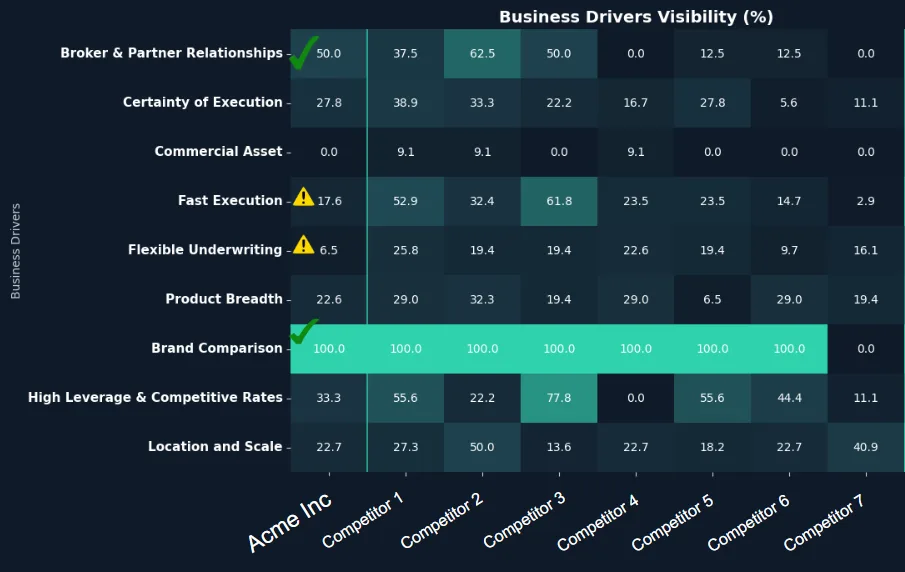
In one audit example for “Acme Inc”:
- Strong visibility in “Nationwide Scale & Reliability.”
- Strong presence in “Broker Relationships.”
- Zero association with “Flexible Underwriting.”
The implication was simple: The lender would not appear in AI comparisons for complex or credit-variance deals. This is how AI narrows your pipeline without you knowing it.
What to Audit
You must measure:
- Frequency of brand mentions in driver-specific prompts
- Co-occurrence with driver phrases (e.g., “fast closing,” “flexible terms”)
- Visibility share across comparison prompts
If AI does not connect your brand to the driver, the market will not either.
2. Measuring Persona Visibility in AI Search
Which ICPs Does AI Associate You With?
Every lending firm serves multiple personas:
- High-Volume Flippers
- Portfolio Scalers
- Independent Brokers
- Residential Developers
- Small-Balance Multifamily Investors
AI search operates through persona-framed prompts:
- “Best lenders for residential developers in Texas”
- “Who funds DSCR portfolios nationwide?”
- “Reliable bridge lender for repeat brokers”
If your brand never appears in “Residential Developer” prompts, you are invisible to that ICP in AI search. This is not about traffic. It is about coverage.
What Persona Gaps Look Like
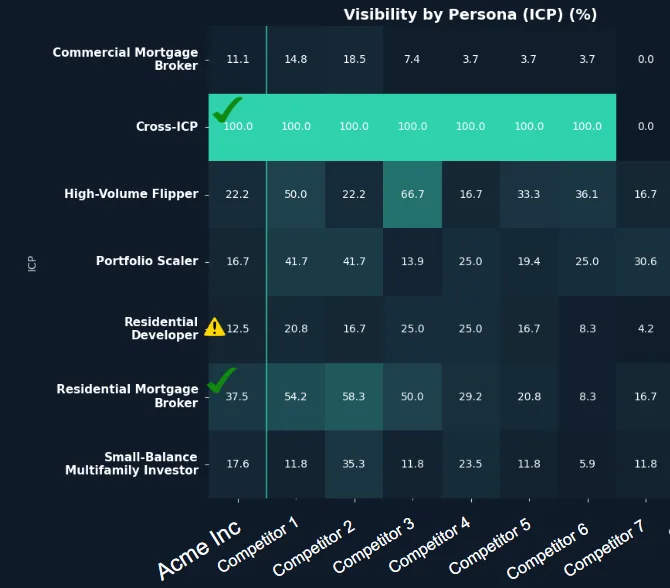
In one audit for “Acme Inc”:
- Strong visibility for Independent Brokers
- Strong visibility for High-Volume Flippers
- Poor visibility for Residential Developers
The implication:
The lender may never appear in developer financing conversations, even if it actively funds those deals. That is a go-to-market blind spot created by AI.
What to Audit
You must measure:
- Brand mentions by persona-specific prompt clusters
- Visibility share across ICP segments
- Gaps where competitors dominate
If your ICP mix in AI differs from your actual strategy, your positioning is misaligned.
3. Conducting a Perception Audit in AI Search
How Does AI Describe You?
This is the most subtle and most dangerous dimension. An example for “Acme Inc”:
When a borrower asks, “Hard money lenders for spec home construction.”
The system clustered that lender alongside large institutional players. It cited the brand Acme Inc -> but in a neutral tone.
Hard Money Lenders to Consider
Here are a few hard money lenders that may be a good fit for your spec home construction loan, based on the search results:
Competitor 1: Their loan program is known for fast closings (as little as 7 days) and 48-hour draw processing. They require a 680 credit score and 15% down payment, with up to 85% LTC.
Competitor 2: Good for investors with varying experience. They can close in as little as 10 days and offer funding for new construction projects.
Acme Inc: Offers loans for various investment strategies with LTV up to 92.5% of LTC and 75% ARV.
Competitor 3: Known for instant loan approval.
Notice how the AI is advocating on behalf of competitors 1,2 and 3, while it has been neutral for Acme Inc.
What to Audit
You must measure:
- Adjectives and phrases used in AI responses
- Tone classification (neutral vs advocacy vs comparative)
- Co-occurrence clustering (which brands appear alongside you)
If you are described in generic terms, you are forgettable. If you are described incorrectly, you are excluded.
How to Audit AI Brand Positioning for the AI Agent
This is where most firms stop. They understand the theory. They don't put it into practice.
Positioning in AI search must be measured through structured prompt testing.
Here is how.
Step 1: Define Your ICPs for AI Search
List your true strategic personas. Not “everyone.” Be precise.
Example:
- Independent Brokers
- Residential Developers
- High-Volume Flippers
- Portfolio DSCR Investors
If your strategy is unclear, your AI positioning will be unclear.
Step 2: Define Strategic Business Drivers
Identify the themes that actually drive lender selection.
Example:
- Speed (24-hour term sheets)
- Flexible underwriting (credit variance, heavy rehab)
- Broker alignment
- Institutional scale
Step 3: Seed Your AI Prompt Library with Real Query Data
Use:
- Google Search Console long queries
- Bing Webmaster AI grounding queries
- Semrush AI tracking data
- Prompt logs from AI monitoring tools
These reveal how users actually frame intent. Long-tail commercial queries today become AI prompts tomorrow.
Step 4: Build a Structured Prompt Library for AI Testing
Your prompt library should include clusters such as:
- “Best X for Y”
- “Compare A vs B”
- “Top lenders for [persona]”
- “Who funds [complex scenario]?”
- Feature-specific queries
Combine:
Personas + Business Drivers + Real Query Data → Prompt Clusters.
A typical audit may include 50-150 structured prompts covering comparison, feature, and persona angles.
Step 5: Run Multi-System AI Search Testing
Execute prompts across:
- Web-grounded AI systems
- Multiple AI engines
- Monitoring tools
Collect:
- Brand mentions
- Business Driver associations
- Persona associations
- Co-occurrence clusters
- Source domains
- Tone classification
Now you are not guessing. You are observing.
Step 6: Analyze AI Positioning Gaps
Look for:
- Zero-coverage personas
- Missing driver associations
- Dominant competitor clusters
- Neutral tone vs advocacy tone
Each gap is a positioning failure. Each failure is correctable.
Why AI Brand Positioning Matters More Than Rankings
Traditional SEO optimizes for keywords, rankings, and sessions.
AI positioning, on the other hand, optimizes for:
- Inclusion in answer sets
- Thematic association
- Persona coverage
- Perception
You can rank #1 for “hard money lender in Texas.” But if the AI agent does not associate you with speed and flexible underwriting, you will not appear in AI summaries for those themes.
And that summary now shapes the shortlist.
The Real Shift: You Are Positioning for the AI Agent
You are no longer positioning only for humans. You are positioning for the AI agent that decides which humans see you. This is not about writing more blog posts. It is about engineering clearer signals to the AI agent.
That agent:
- Clusters you
- Compresses you
- Reinforces what it sees most often
- Filters you out if the signals are weak
If you do not measure:
- Business Driver Alignment
- Persona Visibility
- Perception
You do not understand how AI sees your brand. And if you do not understand how AI sees you, you do not control how the market sees you.
AI now shapes perception before the first call.
The Question
Are you positioned for your human buyer? And for the AI agent that stands between you and them?
If you want to know, you need a structured AI Positioning Audit. And you need to look at what the machine sees, not what your homepage says.