
For: Technical SEOs, Content Engineers, and Marketing Ops
Goal: Engineering "Retrieval-Ready" Data Foundations
Key Tech: AI Visibility, Server Log Analysis, Bing AI Performance Analytics
SEO was about winning the click. AI Visibility is about being the answer. If you’ve read our Executive Guide, you know the stakes.
Read the executive guide to AI visibility
In the traditional search era, a drop in rankings meant fewer sessions. In the AI era, the stakes are binary: You are either the "Grounding Data" for the LLM, or you are invisible.
When a borrower asks an AI for "the best private lender for DSCR loans," and your brand isn't cited favourably, you haven't just lost a visitor; you’ve lost the opportunity to influence the entire consensus.
This piece moves out of the boardroom and into the server room. This is for the team tasked with making the brand 'visible' in AI search.
We’re moving past the "broad strokes." By using Log Analysis and the VAL AI Search Visibility Engine, we will show you how to audit the "silent" traffic from AI bots and ensure your technical foundation is built for retrieval, not just indexing.
How AI Retrieval Works: The Mechanics Behind AI Search
Using our proprietary VAL engine and server logs, we can see exactly how AI bots like ChatGPT-User interact with your site.
Correlating information across different tool results shows that AI bots don't just visit your homepage. The interaction involves multiple steps. AI Visibility starts at the Fan-Out.
The Fan-Out Model: How AI Search Breaks Queries into Sub-Searches
When a borrower asks a complex question like "Best bridge to perm loan programs for real estate", the AI doesn't look for one perfect link. It performs a Fan-Out.
It breaks that one query into three parallel searches:
- Best bridge-to-perm programs
- Comparison of loan rates
- Terms and closing speeds
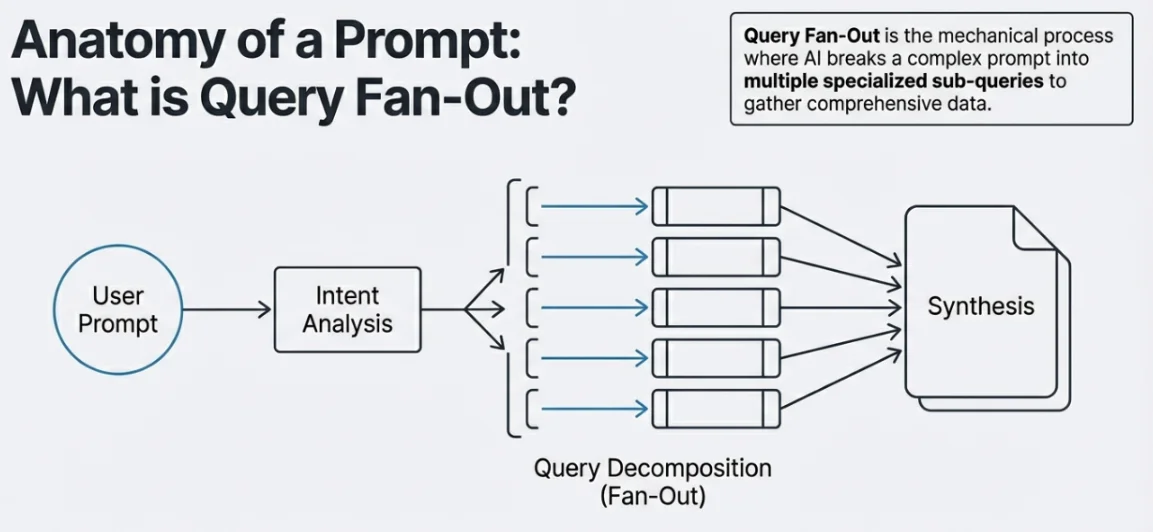
The Stake: These sub-queries fire simultaneously. Within seconds, the AI hits multiple deep-content pages to synthesize an answer. If your metadata (Title, URL, Snippet) isn't laser-focused on these sub-queries, the bot ignores you.
AI Visibility is built on top of SEO. If you aren't indexed and optimized, you don't exist.
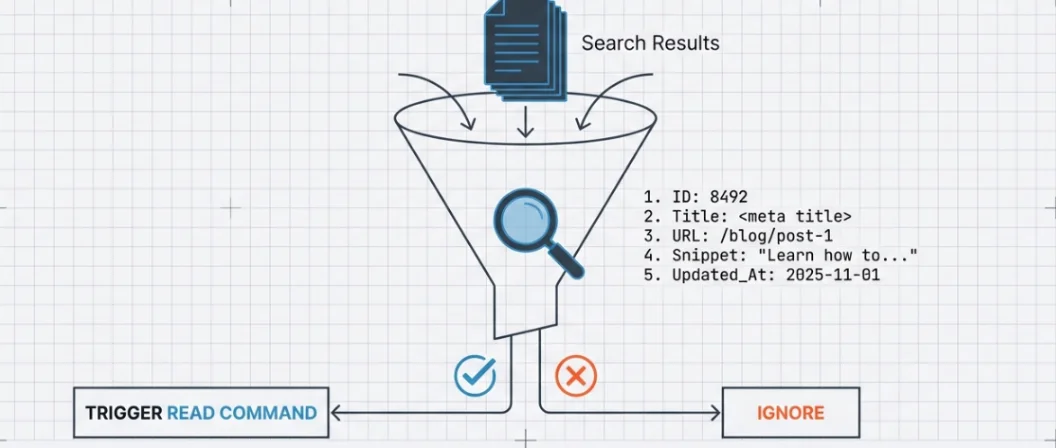
The Practitioner’s Insight: In the age of AI visibility, the 'Top 3' era is over. CTR for the first three blue links is crashing.
In AI retrieval, Page 2 is no longer a graveyard. If your deep-linked data is the best 'Grounding' for a sub-query, the AI will pull you from position 20 and make you the star of the answer.
AI Bot Behavior: Understanding High-Volume Retrieval Bursts
AI bots are aggressive. Server logs confirm this "bursty" behaviour.
- The Swarm: An AI like ChatGPT-User can hit 10+ deep-content pages (guides, blog posts, rate tables) in a single second.
- The Deep Search: Tools like Google’s "Deep Search" can spend minutes reasoning across your data before returning a report.
The Practitioner’s Insight: If your marketing team is only looking at GSC, they are missing 50% of the story. You need server log analysis to see these "bursts."
If the bots are hitting your site but not citing you, your content is being read but rejected.
Consensus and Trust Signals: How AI Chooses Grounding Sources
The AI does not have a "gut feeling." It is a mathematical pattern matcher.
When it synthesizes an answer, it performs a Consensus Check. It compares the data it found during the Fan-Out across multiple domains. If it finds the same "Fact repeated across five pages, that fact becomes the AI's "Truth."
The Warning: Don’t Let Aggregators Hijack Your Brand: Is a third-party directory telling your story for you? If an AI pulls your "Fix-and-Flip" product description from an aggregator instead of your own site, you have lost control. You no longer control the tone, the terms, or the Power Phrases that convert a borrower.
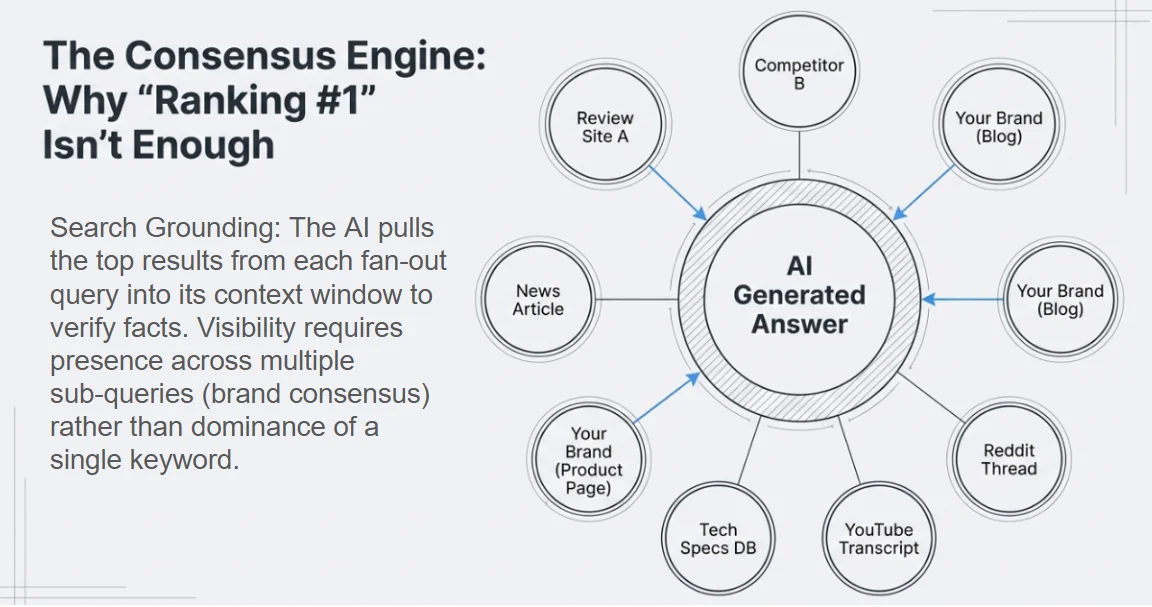
The Practitioner’s Insight: "Colonising" a directory is not a shortcut; it is a commitment to quality. The AI is a rigorous engine of verification; it systematically identifies and ignores low-utility content. To be the "Gold Standard," your content must be dense with facts, real-world rates and specific LTVs.
How to Audit and Monitor AI Search Visibility
The behavior of AI assistants is not static. As Bing Webmaster adds "AI Overviews" to show you grounding queries and clicks, and ChatGPT integrates advertisements, the methodology for tracking visibility must evolve.
AI visibility requires more than a "set and forget" strategy. Success depends on continuously measuring how a machine perceives a brand in real-time.
The 6-Point AEO Audit Framework for Measuring AI Search Visibility
To win in this ecosystem, you need more than SEO; you need Answer Engine Optimization (AEO). You need to measure your AI Visibility through six technical checkpoints derived from real-world LLM behavior:
- Business Driver Alignment: This measures the "latent associations" made by the AI. Does the model map the brand to strategic themes like “Fast Execution” or “Institutional Scale”? If the association is missing, the positioning is failing.
- Persona Visibility: Does the AI recommend you to your target personas, such as "Independent Brokers," or do you have "blind spots" in key markets?.
- Market Fragmentation: AI search is a "long tail" game. Track your "mentions" across hundreds of prompts to see if you are capturing a dominant share of the conversation.
- Similarity Mapping: This defines the "Peer Group." If an institutional firm is grouped with "Hard Money Brokers," the technical signaling is misaligned.
- Source Authority: Identify which domains (aggregators, industry journals, or your own site) the AI uses as its primary "grounding data".
- Perception & Sentiment: Is the AI’s tone Advocacy-based, Neutral, or Critical? Audit for "Power Phrases" that build trust with high-intent users. It is not enough that your domain features in sources of data -> what matters is the perception. If the AI cites the brand but remains neutral while praising a competitor, the brand is merely a data source, not a leader.
Server Log Forensics: Reconstructing AI Retrieval Events
Understanding "The Swarm" of AI bots requires a forensic mindset.
Standard analytics show the crowd; Server Log Forensics reveal the individual bot activity. Reconstructing a retrieval event is like analyzing a crime scene:
- The Sequence: The "CCTV footage" of the logs shows the exact path of a bot, like ChatGPT-User, hitting ten deep-content pages in under a second to satisfy a single user intent.
- The Fingerprints: Tracking the specific Bot and request paths reveals whether an AI is "strip-mining" data for a citation, or for its training.
- The Clues: Logs reveal whether the bot found the evidence it needed or if it encountered "speed breakers" that caused it to abandon the request and look elsewhere.
The AI Visibility Stack: Tracking AI Citations and Bot Activity
To understand AI visibility, you must use information from across the tools and logs available. Traditional tools (GSC, GA) provide the "what," while specialized AEO tools provide the "why."
- Bot Activity: Continuously monitor visits from user agent bots and crawlers. Increased activity is the lead indicator of upcoming AI citations.
- Consumption Mapping: Identifying which specific rate sheets, loan guides, or data tables are being consumed. If bots are visiting but citations are missing, it provides a direct feedback loop to adjust "Retrieval-Readiness."
- The Verification Filter: Identify which content gets consumed but not cited. Correlate bot visits with insights from Bing Webmaster, Semrush, and Otterly.ai. Verify that your content passes the "Utility Filter" rather than being discarded as noise.
Engineering Retrieval-Ready Content for AI Search
Once the mechanics of retrieval are clear, the objective shifts from "creating content" to engineering signals.
In an AI-first ecosystem, the goal is not to attract a human click but to provide the specific data fragments an AI assistant requires to ground its response. Remember, it is the one conducting the search and research on your behalf.
Take up the following steps to get the best out of your content.
1. Optimizing for AI Grounding Queries
Use Bing Webmaster’s AI Performance Dashboard to see the exact "Grounding Queries" that lead to your citations.
- If your site is cited for "hard money lenders in Connecticut" but ignored for "DSCR loan requirements," you have a factual coverage gap.
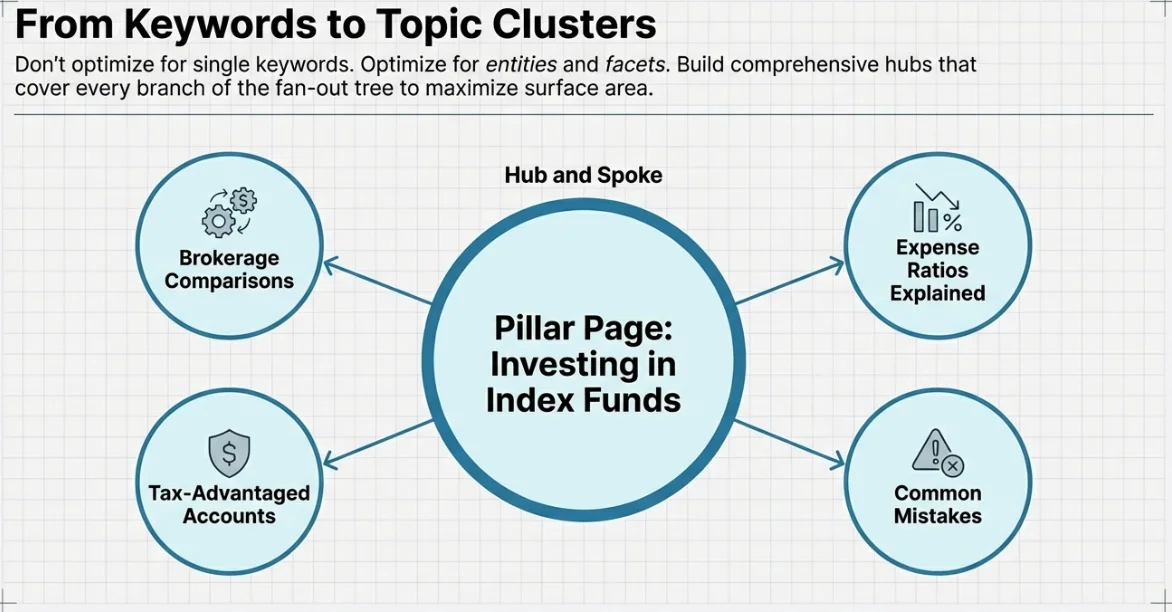
- Keywords are insufficient. Retrieval requires Structured Data Tables and FAQ Schema that provide raw facts, LTV ratios, credit minimums, and loan-to-cost (LTC) data. These are the "building blocks" the AI needs to answer a sub-query.
2. The 2026 Retrieval-Ready Content Blueprint for AI Citation Optimization
Traditional SEO focuses on search volume; Precision Engineering focuses on Citation Potential. The shift in strategy is fundamental:
| Strategy Component | SEO Focus | Precision Engineering (SEO++) |
|---|---|---|
| Content Focus | Broad "how-to" guides for traffic. | Deep-dive "Business Driver" data for retrieval. |
| Measurement | Keyword rankings and sessions. | 6-point AEO Audit |
| Tech Focus | Meta tags and header tags. | Audit and Analyse through First Principles |
| Authority | Backlink volume. | Consensus Building across trusted nodes. |
3. From AI Citation to Brand Advocacy: A Practitioner’s Roadmap
Moving a brand from an "Occasional Mention" to a "Top Pick" requires a closed-loop engineering process. Citation alone is not the win; the objective is Advocacy.
It does not help if you are listed along with your competition, and they are mentioned with positive terms like “well known”, while you just get your products listed.
- Audit Logs & AI Perception: Identify which pages are getting "hits" from AI bots but failing to convert into "citations." Also, identify those that contribute to citations. Are the citations: positive, neutral, or negative?
- Inject Power Phrases: Update the high-retrieval pages with specific "Power Phrases" (e.g., "24-hour term sheets") identified in the AEO Audit.
- Validate via Synthetic Prompting: Re-run the prompts to see if the AI's "Sentiment Tone" shifts from Neutral to Advocacy.
Summary
AI Search Visibility is a game of Signal-to-Noise Ratio.
Precision Engineering creates the signal. By utilizing server log forensics and AI-specific analytics, a brand can cut through the clutter and ensure it is the clearest, most trusted signal in the retrieval pool.