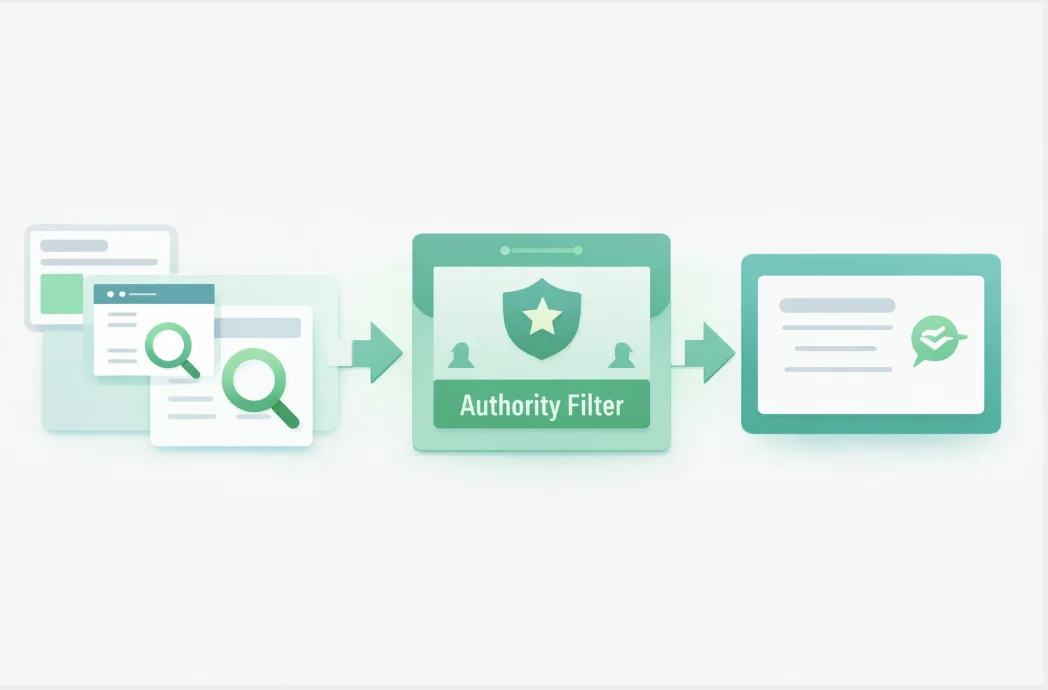
When a borrower asks an AI system:
“Who are the best private lenders for a commercial bridge loan?”
The AI does not invent the answer. It gathers evidence from the web. It scans industry news, directories, company sites, and even broker forums. The AI then weaves these threads into a single, definitive answer.
The brands it cites gain immediate visibility. The brands it ignores effectively disappear from the conversation.
AI citations usually emerge from two reinforcing signals:
- What you know (Topical Authority).
- Who trusts you (External Validation).
Understanding how these signals interact is essential for improving visibility in AI search.
Our Methodology: Cracking the AI Search Code
We didn't guess; we conducted an audit in early 2026.
We pushed 165 high-intent prompts through web-grounded AI systems to see who the machine chose, and why. We tested the most competitive "Battlegrounds" in the lending space:
- Speed: Fast-closing lenders and certain execution.
- Niche: DSCR, Lease-up, and Industrial Flex.
- Persona: Broker-friendly programs vs. direct-to-investor deals.
We analysed not just the responses, but also the sources mentioned in the meta-information returned by the grounding API.
The Key Observation:
While “Who trusts you” still matters, it isn’t the kingmaker. “What you know” matters equally. If you provide clear, structured answers across a cluster of related questions,the AI keeps encountering your site while gathering information. The sources it runs into repeatedly are the ones that end up being cited.
This chart shows the sources of citations and the brands that were cited:
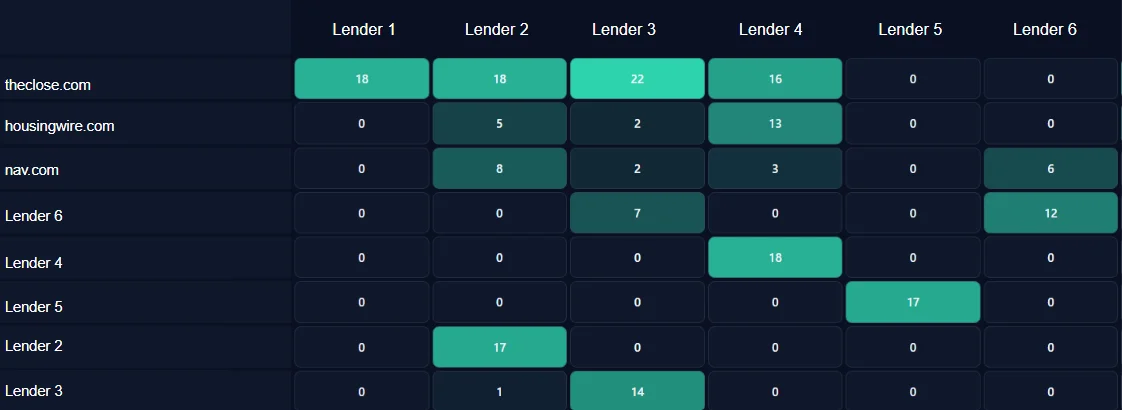
Key observations from the chart:
- Lender 2,3,4 receive citations from multiple independent sources, including both their own site and industry media.
- On the other hand, Lender 5 has citations only from its own site.
- Lender 1 has citations only from off-site sources.
The lenders that won the most citations (Lender 2,3,4) were those with a combination of Topical Authority and External Validation.
Lender 1 and 5 citations show that even if the External Validation was low, Topical Authority could make up for it, and vice versa.
The Great Fragmentation
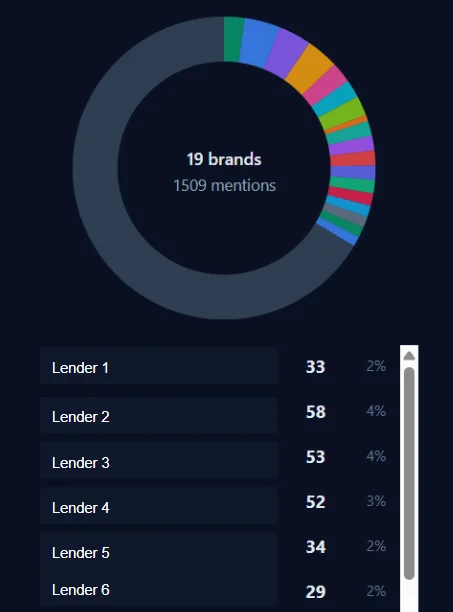
In AI search, there is no "Winner Take All."
In our analysis of 165 industry prompts, the AI didn't just stick to the big lenders. It cited 489 unique brands. On average, every single AI response introduced the borrower to nine different lenders. Even the market leaders are struggling to be heard, with a Share of Voice hovering between only 2% and 4%.
The chart shows the share of voice for top 19 brands with largest citations.
The Takeaway: No one dominates the AI search yet. Visibility isn't about being the biggest brand; it’s about being the most relevant answer to a specific sub-question.
Share of Voice (SOV) measures how often your brand appears compared to competitors in conversations about your industry. If the market conversation is a pie, SOV is the size of your slice. In AI search, it means: out of 100 mentions of you and your competitors in AI answers, how many times your brand is mentioned.
How AI Breaks Down Your Customer’s Question and Assembles the Answer
Modern AI doesn't search; it scouts and assembles. Before generating a response, the system retrieves relevant information from the web and evaluates which sources help answer the user’s question.
This process typically includes three stages.
Step 1: AI Search Decodes the Intent
The system first analyzes the user’s intent. For example:
“Best commercial bridge lenders for condo acquisitions.”
The AI extracts the intent of the request: the loan type, the asset, and the borrower’s hidden needs. This decoding of the intent guides the downstream retrieval process.
Step 2: The Multiplier Effect: Turning One Search Into Many
AI systems rarely perform a single search. Instead, it takes your one question and explodes it into a dozen different searches.
For example, the user’s prompt could be broken into the following queries:
- Commercial bridge lenders condo
- Reliable bridge lenders closing speed
- Broker-friendly private lenders
- Bridge lenders certainty of execution
We have seen one borrower question can become 3-10 separate retrieval searches.
These searches run in parallel. Each one retrieves information from different sources. This fan-out process explains why adjacent topics often influence AI citations. A site that answers many of these subqueries becomes more visible during retrieval.
Hence the need to create “Topical Authority”.
Step 3: The Final Filter: How AI Search Picks the Winners
Once the AI has scanned the web, it doesn't just dump information. It performs an audit. It evaluates every page against three strict criteria:
- Utility: Does this content actually solve the user's problem?
- Authority: Is this source backed by independent proof?
- Structure: Is the information clear enough for a machine to parse?
The AI then "grounds" its response, building the final answer only from the evidence retrieved from these sources.
The Takeaway for Leadership: Visibility isn't about being "on the web." It's about being the most useful, structured, and credible answer to the AI's internal checklist. If you help the AI do its job, the AI will help you reach your customer.
Why Depth Wins the AI Search
One pattern appears consistently in AI search testing. AI systems often cite websites that cover an entire topic cluster well, not just brands that appear across many external domains.
When the AI "fans out" a single prompt into ten sub-questions, it creates ten opportunities to be found. If your site provides the best answer for seven of those ten questions, you occupy 70% of the AI’s "retrieval set" for that session.
The Real Chain Reaction:
- Cluster Density: You publish deep content across a specific niche (e.g., Condo Bridge Loans).
- Multi-Point Retrieval: During a single complex query, the AI’s scouts find your pages again and again.
- Statistical Dominance: Since you appear most often in the search results, the AI "grounds" its final answer in your data.
You don't win because the AI "remembers" you; you win because you are the most frequent high-quality signal. In practice, the sequence often looks like this:
subquery relevance → repeated retrieval → topical authority → citation
This explains why some sites receive AI citations even without widespread mentions across high-authority domains.
Who trusts you: Why Consensus Matters in AI Search
AI systems rarely trust a single source. They look for consensus across independent signals. The system cross-checks your claims against a network of independent voices.
- The Gatekeepers (Industry Press) When an editorial site with "eyes on the street" mentions your deal flow, the AI treats it as a verified fact. Editorial oversight acts as a trust-signal the AI can't ignore.
- The Databases (Directories & Aggregators) AI is a pattern-matching machine. It scours financial directories for structured data, your geographic reach, your loan types, your criteria. If you are in the database, it is easier for AI to retrieve and present the information.
- The Evidence (Podcasts & YouTube) The AI "listens" to transcripts. When a practitioner on a podcast describes your "speed to close," that insight is extracted and used. Video and audio are no longer just "content", they are data inputs.
- The Street Talk (Broker Forums) Finally, the AI also consumes the sentiment. It looks at broker discussions to find the truth behind the marketing. Are you reliable? Do you fund on time? These "sentiment signals" decide if the AI recommends you, or warns the user away.
Your visibility depends on a "Chorus of Approval." The more independent sources that say the same thing about you, the higher the AI's confidence in citing you.
The Strategic Shift: From Rankings to Retrieval
Traditional SEO asked: “How do I get to Page One?”
AI search asks: “Who provides the most useful answer?”
Visibility no longer depends on backlinks or clever keyword density. It depends on being the "Source of Truth" for the AI’s internal checklist. To win, you must move beyond rankings and focus on three pillars:
- Topical Dominance: Owning the niche.
- Machine Readability: Making your data easy to harvest.
- Market Consensus: Getting the industry to back your claims.
This is the foundation of Generative Engine Optimization (GEO). It ensures that AI retrieval systems repeatedly encounter your brand as a trusted source.
Executive Takeaway
AI answers are not built from a single website; they are woven from a network. The brands that dominate the AI era aren't just the loudest, they are the most useful.
In this new landscape, you are either the cited authority or you are invisible.
Does the AI see your brand?
Our AI Visibility Audit gives you the map. We identify:
- Your Footprint: Which prompts trigger your brand?
- Your Territory: Which topic clusters do you own?
- The Gap: Where is the AI choosing your competitors instead of you?